Studio journal
Lesso: building the first AI lesson builder for language teachers
Language teachers were spending more time preparing lessons than delivering them. Lesso is the AI-first platform we built to generate complete lesson structures—content blocks, student activities, speaking practice, and classroom workflows—in minutes instead of hours.
Introduction
At GUDZI STUDIO, we are always interested in solving problems that affect professionals on a daily basis. While artificial intelligence has transformed many industries over the last few years, education remains one of the areas where professionals still spend an enormous amount of time on repetitive and manual work.
When we started talking to language teachers, one pattern became obvious almost immediately. Most educators were spending significantly more time preparing lessons than actually delivering them. Creating a quality lesson often involved collecting resources from multiple websites, generating worksheets, writing discussion questions, preparing speaking activities, searching for images, building homework assignments, and adapting content to the student's level. Even experienced teachers who had developed their own workflows often needed anywhere between thirty minutes and several hours to prepare a single lesson.
The existing tools available on the market helped with individual parts of the process, but none of them addressed the entire workflow. Teachers would typically use ChatGPT for content generation, Canva for visual materials, Google Docs for organization, YouTube for listening activities, and various educational websites for interactive exercises. While each tool solved a specific problem, the overall experience remained fragmented and inefficient.
This observation became the starting point for Lesso.
Lesso was envisioned as an AI-first platform specifically designed for language teachers. Rather than helping educators generate isolated pieces of content, our goal was to create a system capable of generating complete lessons, complete learning experiences, and complete teaching workflows.
The core idea was simple: a teacher should be able to describe what they want to teach, specify the level of their students, define the lesson duration, and receive a complete lesson structure within seconds. What sounds simple from a user's perspective required extensive work behind the scenes.
The problem
The lesson preparation process has traditionally remained largely unchanged for decades. Teachers continuously search for content, adapt materials, organize resources, and build activities manually. While AI tools have recently accelerated content creation, they often generate disconnected outputs that require significant editing and restructuring before they become classroom-ready.
One of the biggest challenges we identified was that most AI systems do not understand lessons—they understand prompts. A teacher might ask an AI model to create vocabulary exercises, grammar explanations, or speaking questions, but creating an effective lesson requires much more than individual activities. A lesson needs structure. It needs progression. It needs balance between input and output. It needs interaction. Most importantly, it needs to keep students engaged throughout the learning process.
Teachers therefore found themselves spending considerable time transforming AI-generated content into something usable. We believed the lesson itself should become the primary output. Instead of generating individual pieces, the platform should generate the entire framework and allow teachers to refine it according to their needs.
Product vision
Our vision for Lesso was to become the operating system for modern language teaching. We wanted teachers to open a single platform where they could create lessons, manage students, generate activities, conduct speaking practice, track progress, and collaborate with other educators.
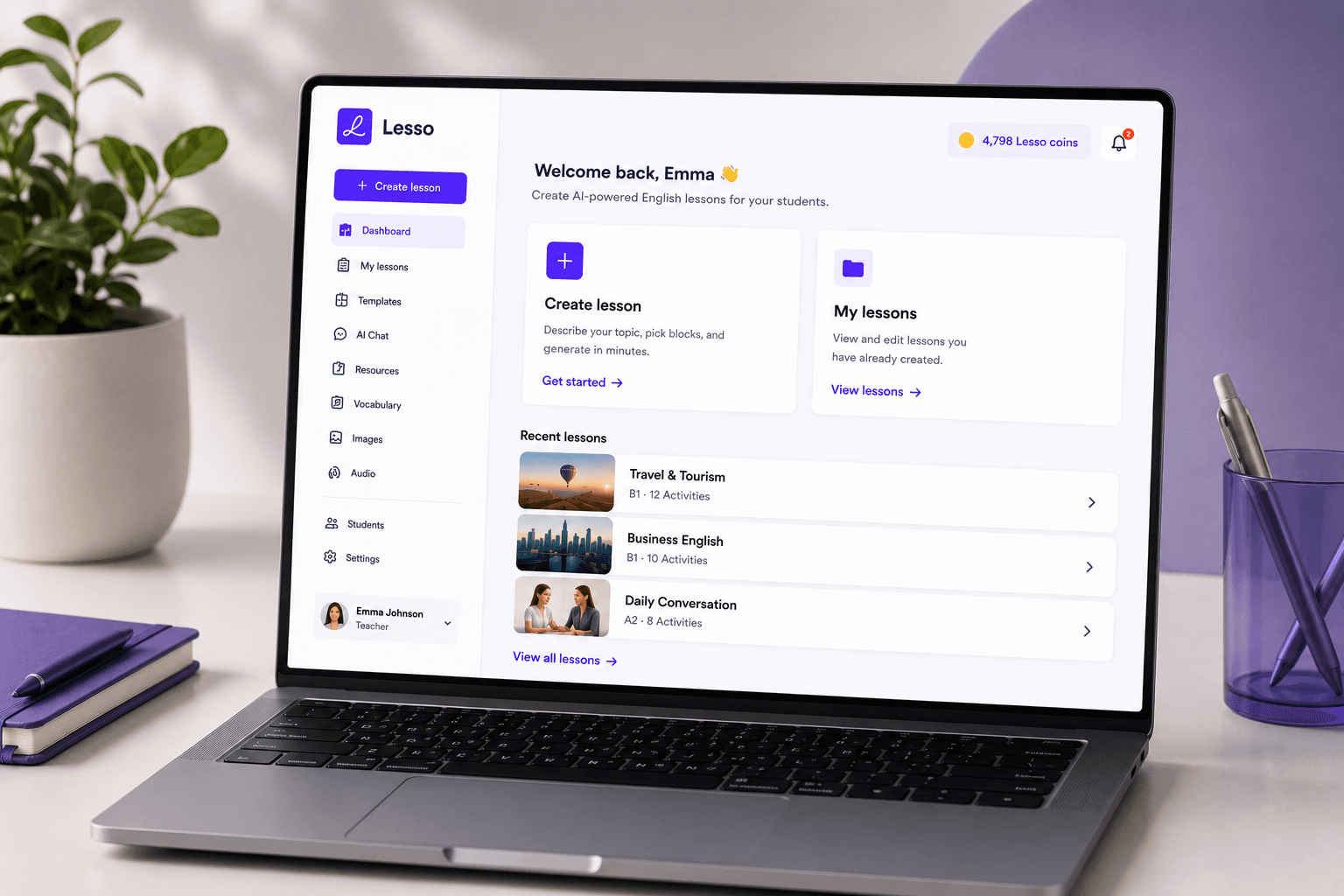
The first version of the product focused heavily on lesson creation because that represented the largest time investment for most teachers. The experience begins with a simple prompt. A teacher describes the lesson topic, selects the target language, chooses the student's proficiency level, specifies lesson duration, and provides any additional requirements.
For example: “Create a sixty-minute B1 lesson about travelling by plane with vocabulary practice, role-play activities, speaking exercises, listening tasks, and homework.”
Instead of returning a wall of generated text, Lesso creates a complete lesson structure organized into editable blocks. This distinction fundamentally changes how teachers interact with AI. The platform no longer behaves like a chatbot. It behaves like a lesson-building assistant.
Designing the lesson builder
One of the most important product decisions involved choosing how lessons would be represented inside the platform. We explored traditional document-based editors, page builders, and curriculum-style structures. However, each approach introduced limitations when it came to flexibility and future expansion.
Eventually, we adopted a block-based architecture. Each lesson is composed of independent blocks that can be generated, rearranged, modified, duplicated, or removed. This approach offers several advantages. First, teachers remain in control of the final lesson. Second, AI-generated content can be mixed with manually created materials. Third, new block types can be introduced without affecting existing lessons.
The platform currently supports multiple categories of lesson blocks. Content blocks include vocabulary explanations, grammar sections, reading passages, listening activities, speaking prompts, images, board games, and text-based educational materials.
Student task blocks include multiple-choice exercises, true-or-false questions, fill-in-the-blank activities, matching exercises, short-answer tasks, writing assignments, grammar practice, voice messages, and AI-powered conversations. Custom blocks allow educators to upload their own PDFs, images, audio files, videos, and documents.
This architecture enables teachers to create highly personalized lessons while still benefiting from automated generation.
AI-powered speaking practice
One of the most ambitious features we developed for Lesso was AI conversation practice. Language learning depends heavily on communication. Unfortunately, speaking remains one of the most difficult skills to practice consistently. Students often have limited opportunities to speak outside the classroom, and teachers rarely have enough time to provide individual conversational practice to every learner.
We wanted to solve this challenge through AI. The AI conversation system allows students to engage in realistic scenarios directly within the lesson. Rather than answering static questions, learners participate in dynamic conversations that adapt to their responses.
Students can practice situations such as booking hotels, attending job interviews, ordering food, participating in business meetings, making travel arrangements, or handling everyday conversations. The objective was not to replace teachers but to provide students with additional opportunities to practice communication independently.
For language learners, repetition is critical. AI conversations allow students to repeat scenarios as many times as necessary without requiring teacher intervention.
Community and lesson sharing
As we spoke with educators, another opportunity became clear. Teachers create incredible resources every day. However, much of this content remains locked inside personal folders, cloud drives, or classroom documents.
We wanted to create an ecosystem where teachers could discover, share, and reuse high-quality educational content. Lesso includes a lesson-sharing system that enables educators to publish their lessons and browse materials created by others. This feature transforms lesson creation from an isolated activity into a collaborative process.
Instead of starting from scratch every time, teachers can adapt existing lessons, build upon community contributions, and discover new teaching approaches. Over time, we envision this becoming one of the platform's most valuable features.
Design philosophy
From a design perspective, simplicity was a core requirement throughout the project. Artificial intelligence products often expose too much complexity to users. Teachers should not need to understand prompts, tokens, models, or AI configurations. They should focus on teaching.
Our design philosophy was based on reducing cognitive load and creating an interface that feels approachable even for educators with limited technical experience. The platform uses a clean visual hierarchy, spacious layouts, clear navigation, and familiar educational terminology.
Every design decision was evaluated through a single question: “Will this help teachers accomplish their goals faster?” This approach helped us create a product that feels powerful without feeling overwhelming.
Technical implementation
Building Lesso required combining modern web technologies with sophisticated AI workflows. The frontend was developed using React, Next.js, and TypeScript, enabling a highly interactive user experience while maintaining performance and scalability.
The backend architecture was designed around modular services responsible for lesson generation, activity generation, user management, content processing, and future AI capabilities.
Special attention was paid to generation pipelines. Producing high-quality lessons requires more than simply sending prompts to a language model. The system needs to understand lesson structure, learning objectives, educational progression, time allocation, and student proficiency levels.
We developed custom workflows that transform user requirements into structured educational content rather than generic AI output. This educational layer represents one of the most important differentiators of the platform.
Outcome
Lesso successfully transforms one of the most time-consuming aspects of language teaching into a streamlined, AI-assisted workflow. Teachers can now move from idea to lesson significantly faster while maintaining complete control over the final result.
The platform reduces preparation time, increases flexibility, and enables educators to deliver richer learning experiences without increasing workload. Most importantly, Lesso demonstrates how artificial intelligence can enhance educational workflows without replacing the expertise and creativity that teachers bring to the classroom.
For GUDZI STUDIO, the project represents more than just another SaaS platform. It is an example of how thoughtful product design, educational understanding, and modern AI capabilities can come together to solve a real-world problem for thousands of professionals worldwide.
As the platform continues to evolve, our goal remains unchanged: helping language teachers spend less time preparing lessons and more time teaching.
Explore the work
For a phase-by-phase breakdown of Lesso—including product features, design approach, technical architecture, and outcomes—open the portfolio case study linked beside this article. If you are planning a similar AI product where education, workflow design, and generation pipelines have to feel like one system, we also document how we approach that under AI Integration and AI Agent Development.